
From the caves of Venezuela to the rocks on Mars: a new method for studying extreme environments
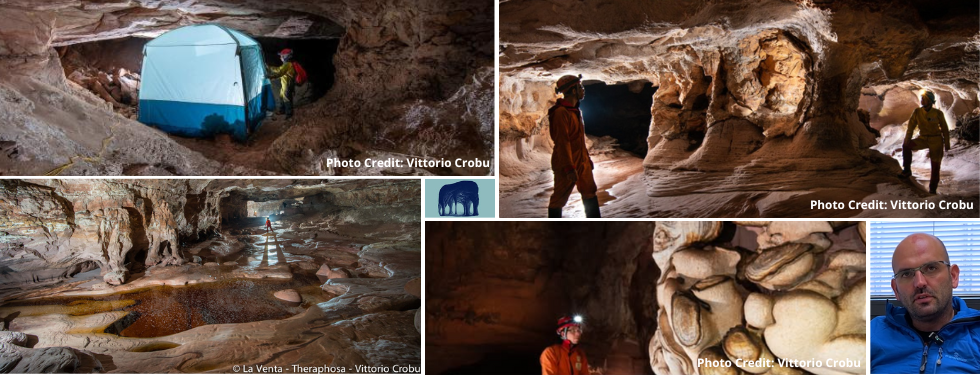
In the depths of the Imawarì Yeutà cave, in the heart of Venezuela’s Auyán-tepui, an international group of researchers has, for the first time, conducted a complete in-situ study of silica stromatolites — extremely rare and still poorly understood structures. The work, published in the journal Biogeosciences, opens new perspectives for the exploration of extreme environments, both on Earth and beyond. Silica structures similar to those in the Venezuelan cave have in fact been observed on Mars by the Spirit rover: whether these formations may have a biological origin remains an open question, but compact and portable instruments like those used by the team could one day provide an answer directly on the Red Planet.
The structures investigated in the study are silica stromatolites: rock formations composed of opal (amorphous silica), whose growth is generally associated with the activity of photosynthetic microorganisms. Their presence in a completely dark and isolated environment such as that of the Venezuelan cave represents one of the most fascinating geo-microbiological enigmas of recent years.
The research stems from a 2023 expedition during which the team of Italian and Venezuelan scholars set up a true research camp inside the cave, bringing in advanced instruments never before used in such a remote context.
Among the technologies employed by the researchers from the University of Padua were a hyperspectral camera, which made it possible to analyze the composition of the silica structures, and a 3D laser scanner used to obtain ultra-high-resolution models of the formations.
The researchers from the University of Bologna also used instruments capable of detecting microbiological activity directly in vivo, identifying active cells on the rock surfaces. Completing the picture, the MinION device enabled DNA sequencing directly inside the cave, with samples extracted and analyzed on site, without the need to transport them outside.
“In this work, we developed, applied, and validated directly in the field microbiological procedures to study the extraordinary silica stromatolitic structures found in the quartzite caves of the Venezuelan tepuis” says Martina Cappelletti, first author of the article and researcher at the Department of Pharmacy and Biotechnology of the University of Bologna. “Our analyses made it possible to detect microbial activity and identify the main bacteria that may enable the development of these structures. At the same time, we demonstrated that DNA analyses and microbiological studies can be carried out in real time even in extreme and isolated locations, revealing new aspects of the role of microorganisms in the formation of stromatolites in dark, nutrient-poor environments such as the remote and ancient caves of the tepuis.”
“For the first time, we were able to study these extraordinary structures directly in their environment, without collecting samples. This approach allows us to better understand the interaction between geology and microbiology under extreme conditions, with important implications for planetary exploration” explains Francesco Sauro, speleologist and researcher at the Department of Geosciences of the University of Padua.
The research group benefited from funding provided by the Bachelor’s Degree Programme in Genomics at the University of Bologna, which supplied the portable sequencer and the reagents needed for DNA sequencing, as well as from the support of Miles Beyond Srl, which purchased and provided the Bento Lab portable laboratory.
Francesco Sauro’s contribution to the study is part of the activities supported by the project “The Geosciences for Sustainable Development,” funded by the Italian Ministry of University and Research (MUR) – Departments of Excellence 2023–2027. Thanks to this funding, the Department of Geosciences of the University of Padua and the Department of Pharmacy and Biotechnology of the University of Bologna were able to develop innovative technologies, train multidisciplinary teams, and conduct scientific missions in extreme environments, strengthening international leadership in the study of geomicrobiology and geomorphology in extreme settings and opening new perspectives for research on Martian analogues.
Press Information
- Paper: On-site microbiome study of silica structures in a subterranean Mars analog environment
- Authors: Martina Cappelletti, Giacomo Broglia, Andrea Firrincieli, Ettore Lopo, Alice Checcucci, Daniele Ghezzi, Federico Pisani, Freddy Vergara, Bruno Casarotto e Francesco Sauro. Biogeosciences (Vol. 22, 2025), pp. 6275–6289.
- DOI: 10.5194/bg-22-6275-2025