


Mount Etna volcanic materials as terrestrial analogues of lunar regolith
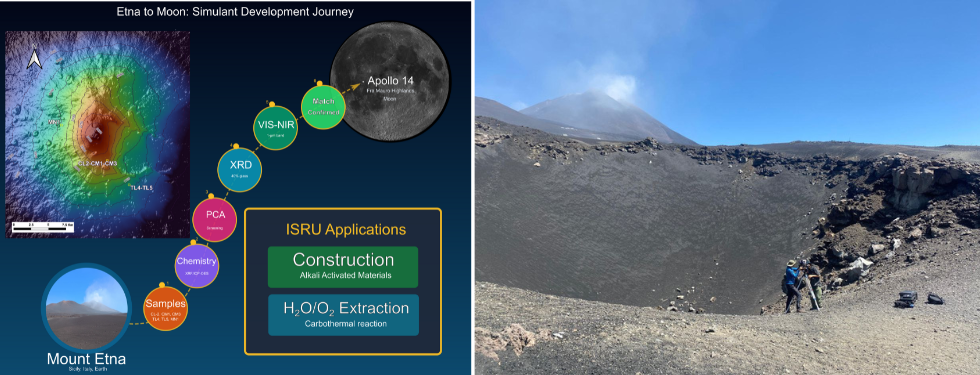
A research team led by the Department of Geosciences of the University of Padua has identified volcanic materials from Mount Etna that closely resemble lunar soil, offering a valuable resource for testing technologies needed for future Moon missions.
The study, recently published in Materials Today Advances focuses on the search for terrestrial analogues of lunar regolith, which are essential for developing In-Situ Resource Utilization (ISRU) technologies and for testing mission hardware before deployment on the Moon. Because only a limited amount of lunar material was returned by the Apollo missions, and routinely transporting material from the Moon is neither practical nor cost-effective, realistic Earth-based simulants are crucial for advancing lunar exploration.
Mount Etna, one of the most geologically diverse volcanoes in the world, offers an exceptional natural laboratory for planetary analogue studies. Its volcanic products span a wide range of compositions, similar to both lunar mare and highland terrains. In this research, the team investigated pyroclastic deposits and basaltic samples collected from three sites: the Cisternazza pit crater, and the Monte Nunziata and Tre Livelli lava tubes.
Through a combination of chemical, mineralogical, and spectroscopic analyses, the team identified one sample from the Cisternazza pit crater—named CL2—as particularly significant. Statistical analysis revealed a strong affinity between CL2 and lunar highlands material from the Fra Mauro formation, sampled during the Apollo 14 mission.
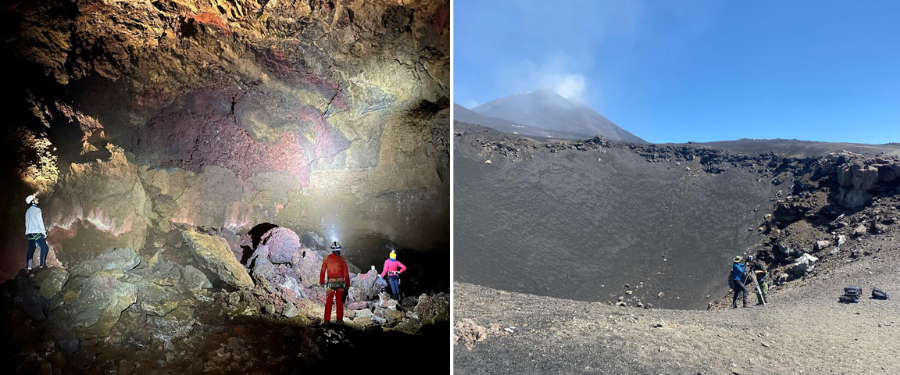
“In the search for realistic lunar simulants, Mount Etna turned out to be a truly unique geological environment”, explains Giacomo Melchiori, Ph.D. student at the Department of Geosciences and one of the main author of this study. “After studying several volcanic deposits, we discovered something remarkable: this material is similar to what Apollo astronauts found on the Moon”
Beyond compositional similarity, the researchers also evaluated the practical usability of the material for lunar exploration. Engineering tests showed that alkali-activated materials produced from CL2 can reach compressive strengths of up to 16.4 MPa, values comparable to other lunar highlands simulants used for construction studies. In addition, modeling of carbothermal reduction processes indicated favorable yields for oxygen and water extraction—two critical resources for long-term human presence on the Moon.
The study is part of Space It Up, Italy’s national consortium for space innovation funded by the Italian Space Agency (ASI) and the Ministry of University and Research. Within the project, the team contributes to activities focused on robotics and ISRU technologies for planetary exploration, with the aim of translating laboratory research into operational solutions for space missions.
“Our goal is to develop technologies that space agencies can actually use in real lunar missions. From laboratory experiments to the Moon — that is the path we are building,” explains Francesco Santoro, researcher at the Department of Geosciences and CISAS and corresponding author of the study.
By linking terrestrial volcanology with planetary exploration, this research highlights the central role of Earth-based geoscience in preparing the next generation of lunar missions.
PRESS INFORMATION
“Volcanic deposits from mount Etna (Italy) as high-fidelity lunar simulants for In-Situ Resource Utilization (ISRU) applications”, Materials Today Advances
Doi: https://doi.org/10.1016/j.mtadv.2025.100678
Giacomo Melchiori, Francesco Santoro De Vico, Alice Dottori, Riccardo Pozzobon, Luca Valentini, Patrizia Ferretti, Alessandro Bonetto, Michéle Lavagna, Sonia Calvari, Matteo Massironi,